Celecoxib vs Diclofenac: Clinical Comparison, Potency & Side Effects
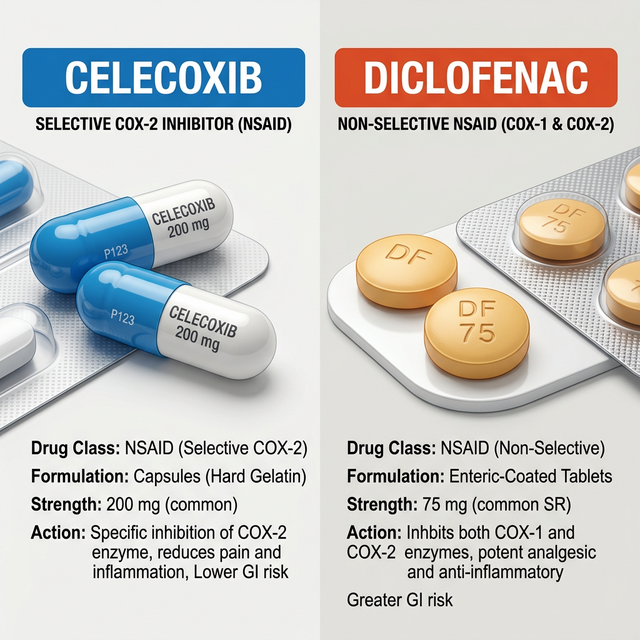
Celecoxib (Celebrex) and Diclofenac (Voltaren) represent two of the most potent non-steroidal anti-inflammatory drugs (NSAIDs) utilized in modern U.S. rheumatology and orthopedic practice. While traditional NSAIDs like ibuprofen are commonly used for minor aches, Celecoxib and Diclofenac are specifically engineered for the 'heavy lifting' required to manage chronic, debilitating joint inflammation. However, they achieve their results through vastly different biochemical pathways, leading to distinct safety profiles that dictate their use in the United States.
In the USA, the clinical decision between these two often centers on a critical trade-off: Gastrointestinal (GI) safety versus extreme anti-inflammatory potency. Celecoxib is a selective COX-2 inhibitor, designed specifically to spare the stomach lining, while Diclofenac is a non-selective inhibitor that offers unparalleled 'joint-penetrating' relief at the cost of higher stomach risk. This 800+ word guide provides a deep-dive analysis into their pharmacological mechanics, the clinical significance of 'Sulfa' allergies in the USA, and the evolving role of topical versus oral diclofenac in American pain management.

Dr. Kelsey Hopkins, MD
Dr. Hopkins practices rural family medicine in Southern Illinois, with a focus on community healthcare and chronic pain management.
Quick Reference Comparison
| Clinical Feature | Celecoxib | Diclofenac |
|---|---|---|
| U.S. Brand Names | Celebrex | Voltaren, Cataflam, Zorvolex |
| Drug Class | COX-2 Selective Inhibitor | Potent Non-selective NSAID |
| Stomach Ulcer Risk | Lowest in class (GI Sparing) | Significant / High |
| Standard Dosage | 200mg (Once daily) | 50mg and 75mg (Twice daily) |
| Surgical Recovery | Preferred (Less bleed risk) | High-level joint power |
What is Celecoxib (Celebrex)?

Celecoxib is the 'Safety Specialist' of the NSAID family. Developed in the late 1990s as a response to the millions of American patients suffering from NSAID-induced stomach ulcers, it was the first 'COX-2 selective' drug to receive FDA approval. By targeting only the specific enzyme responsible for pain and inflammation (COX-2) and sparing the enzyme that protects the stomach lining (COX-1), it revolutionized U.S. geriatric care.
In the USA, Celecoxib is the primary long-term option for patients with osteoarthritis who also suffer from sensitive stomachs, acid reflux, or a history of peptic ulcers. It is one of the few NSAIDs that some U.S. surgeons permit patients to continue taking closer to surgery because it has a lower impact on blood clotting than traditional agents.
What is Diclofenac (Voltaren)?

Diclofenac is the 'Heavy Hitter' of the traditional NSAID world. In U.S. clinical studies, it consistently ranks as one of the most effective medications for moderate-to-severe joint inflammation. It works globally by shutting down the entire prostaglandin factory. It is unique among NSAIDs for its ability to concentrate in the 'synovial fluid' (the lubricating fluid inside joints), providing targeted relief for 'bone-on-bone' arthritis pain.
American clinicians frequently prescribe Diclofenac for acute inflammatory crises, such as gout flares or severely active rheumatoid arthritis. Since 2020, its topical form (Voltaren Arthritis Pain Gel) has been available over-the-counter in the USA, offering a safer alternative for patients who need joint relief without the systemic side effects of an oral pill.
Mechanism of Action: How They Work
The core difference is 'Selectivity.' Most traditional NSAIDs are like a blanket that smothers all enzymes in the body. Celecoxib is like a precision-guided missile that only hits the target. In the USA, this 'COX-1 Sparing' effect means that the stomach's protective mucus layer remains intact. Diclofenac, however, suppresses both COX-1 and COX-2 with extreme efficiency. While this broad suppression is what makes Diclofenac feel 'stronger' to many U.S. patients, it also means the stomach is left vulnerable to its own acid.
Furthermore, Diclofenac may also inhibit the Lipoxygenase (LOX) pathway, which further reduces inflammatory molecules that other NSAIDs ignore. This multi-pathway action is why Diclofenac is often the U.S. standard for 'refractory' pain that hasn't responded to ibuprofen or naproxen.
Cellular Logic Map
Selectivity
Celecoxib spares the stomach's protective enzymes.
Tissue Potency
Diclofenac is roughly 10x more potent than Ibuprofen.
Peak Dynamics
Diclofenac works faster for acute gout; Celecoxib is for steady relief.
FDA-Approved vs. Off-Label Uses
- Celecoxib: FDA-approved for Osteoarthritis, RA, Ankylosing Spondylitis, and primary dysmenorrhea. In the USA, it is also uniquely indicated for reducing intestinal polyps in patients with FAP (a pre-cancerous condition).
- Diclofenac: FDA-approved for pain, migraine, and dysmenorrhea. Widely used in U.S. podiatry off-label for the rapid management of acute gout symptoms.
Potency and Clinical Strength
In terms of raw pain-score reduction, a major U.S. meta-analysis involving over 70,000 patients found that Diclofenac 150mg daily was significantly more effective for knee and hip osteoarthritis than standard doses of Celecoxib. However, the 'strength' of Celecoxib is its sustainability; American patients can often stay on Celecoxib for years without developing the gastrointestinal distress that frequently forces them to stop taking Diclofenac within weeks.
Bioavailability & Metabolism
Celecoxib is processed by the liver's CYP2C9 enzyme. In the USA, approximately 10-15% of the population carries a genetic 'variant' that makes them slow metabolizers of this drug, leading to potentially dangerous accumulations in the blood. Diclofenac is also liver-metabolized but has a very high 'first-pass' effect, meaning only a fraction of the oral pill reaches the general circulation. This is why U.S. pharmacists emphasize that oral Diclofenac is significantly harder on the liver than Celecoxib.
Half-Life & Duration of Action
Celecoxib has a long half-life of 11 hours, allowing for stable once-daily dosing in American households. Diclofenac's blood half-life is remarkably short (1-2 hours), but its 'joint half-life' is much longer. In the USA, this explains why Diclofenac is often taken twice daily—it provides rapid peaks to kill morning stiffness followed by a second dose to manage evening pain.
Clinical Efficacy and Indications
Celecoxib is considered the 'Gold Standard' for: Long-term management of chronic arthritis in U.S. seniors. Diclofenac is the 'Gold Standard' for: Acute Gout crises, severe menstrual pain, and topical joint relief in patients who cannot tolerate oral pills.
Typical Dosage and Administration
The standard effective dose for Celecoxib in the USA is 200mg daily. This can be taken as one pill or split into 100mg twice. For acute pain, U.S. doctors may use an initial 'loading dose' of 400mg.
Diclofenac is typically dosed at 50mg to 75mg twice per day. In the United States, U.S. clinicians strictly advise taking Diclofenac with food or a full glass of milk to buffer the stomach lining, whereas Celecoxib can be taken with or without food.
Side Effects and Adverse Reactions
While Celecoxib protects the stomach, it shares the same cardiovascular risks as all NSAIDs. In the USA, both medications carry a 'Black Box Warning' regarding the risk of heart attack and stroke. Diclofenac, however, remains the outlier for GI toxicity, with a high incidence of dyspepsia and, in rare cases, silent GI bleeding that can lead to anemia in American patients.
Comprehensive Side Effect Analysis
| Side Effect | Celecoxib | Diclofenac |
|---|---|---|
| Stomach Bleeding | Very Low | Very High |
| Kidney Strain | Moderate | High |
| Heart Risk | High | High |
| Nausea | Low | Moderate |
🔴 Celecoxib Risks
- Headache
- Abdominal pain
- Dyspepsia
- Fluid retention
🔴 Diclofenac Risks
- Stomach pain
- Heartburn
- Bloating
- Skin rash
⚠ Critical Safety Note
Serious adverse reactions require immediate medical attention. The following are life-threatening signs:
- Gastrointestinal Perforation (D)
- Sulfa Allergy reaction (C)
- Sudden Cardiac Death
Safety, Addiction Risk, and Controlled Status
⚠ U.S. Regulation: NONE (Non-Narcotic)
Neither medication is addictive. However, the 'Hidden Danger' of Celecoxib in the USA is the **Sulfa Allergy**. Because Celecoxib contains a sulfonamide chemical group, patients with a known allergy to sulfa-based antibiotics (like Bactrim) can have a severe, potentially fatal allergic reaction. Diclofenac does not contain sulfa but carries the 'aspirin-sensitive asthma' warning common to most NSAIDs in the USA.
- Celecoxib is the only NSAID safe for some U.S. patients with bleeding disorders.
- Diclofenac is available as an over-the-counter gel (Voltaren) in the USA since 2020.
- Both medications are contraindicated for U.S. patients undergoing coronary artery bypass graft (CABG) surgery.
Pharmacy Cost & U.S. Healthcare Access
In the United States, Celecoxib was significantly more expensive for years, but now that it is generic, it is highly affordable. Both are typically covered as 'Tier 1' generics by U.S. insurance plans, costing under $15 for a 30-day supply at national pharmacies like CVS or Walgreens.
Clinical Decision Flow: Which Should You Choose?
U.S. doctors follow the 'GI vs. Heart' logic. If you have history of ulcers, use Celecoxib. If you have severe joint pain and a resilient stomach, Diclofenac is the more powerful tool. However, if you have a history of heart bypass surgery, your U.S. physician may avoid both in favor of acetaminophen.
U.S. Advanced NSAID Selection
Frequently Asked Questions
For your stomach, yes. For your pain, many U.S. patients find Diclofenac (Voltaren) to be slightly more effective for severe joint inflammation.
Generally No. Even though one is a gel, it still enters the bloodstream. Mixing two NSAIDs creates a high risk for kidney and stomach damage in the USA.
It has a chemical structure that includes a sulfonamide group, which is why U.S. patients with Sulfa allergies are told to avoid it.