Codeine vs Oxycodone: Clinical Comparison, Potency & Side Effects
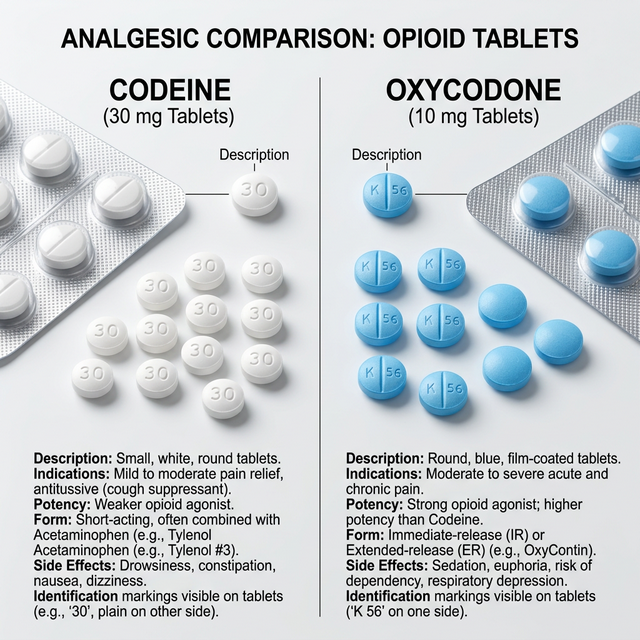
Codeine and Oxycodone (Roxicodone, OxyContin) represent opposite ends of the American moderate-to-severe pain management spectrum. One is a naturally occurring opiate derivative used for outpatient minor surgery, while the other is a potent semi-synthetic powerhouse that has redefined U.S. pain medicine. In the United States, transitioning a patient from Codeine to Oxycodone is a significant clinical milestone, marking a shift from 'Step 2' (Moderate Pain) to 'Step 3' (Severe Pain) on the global pain ladder.
Because Oxycodone is roughly 10 to 15 times more powerful than Codeine milligram-for-milligram, U.S. clinicians must be extremely precise in their dosing to avoid overshooting the appropriate level of sedation. This 800+ word guide explores the massive potency gap, the genetic metabolic lottery of Codeine, and the stringent DEA Schedule II protocols that govern Oxycodone in the modern U.S. healthcare system.

Dr. Kelsey Hopkins, MD
Dr. Hopkins practices rural family medicine in Southern Illinois, with a focus on community healthcare and chronic pain management.
Quick Reference Comparison
| Clinical Feature | Codeine | Oxycodone |
|---|---|---|
| U.S. Potency (MME) | 0.15 (Low) | 1.5 (High) |
| Drug Class | Natural Opiate | Semi-synthetic Opioid |
| Metabolic Path | Requires Liver Conversion | Directly Active Molecule |
| Genetic Reliability | Low (Unreliable in 10% of U.S.) | Extremely High |
| DEA Schedule | Schedule III (Combo) or II | Schedule II |
| Common Brands | Tylenol #3, Tylenol #4 | Roxicodone, OxyContin, Percocet |
What is Codeine?
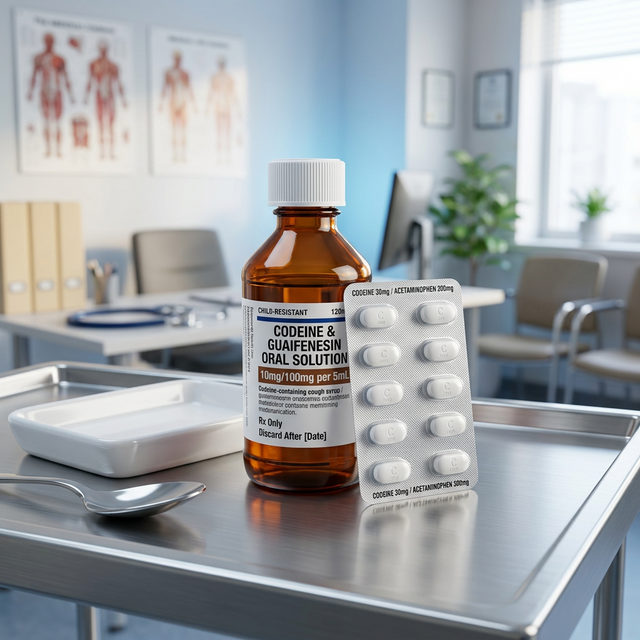
Codeine is a naturally occurring alkaloid derived from the opium poppy and has been a staple of American medicine for over a century. In the USA, it is primarily utilized as an 'intermediate' narcotic for pain that does not respond to Ibuprofen or Tylenol. It is most frequently encountered in the United States as a combination product, such as Tylenol #3 (30mg codeine / 325mg acetaminophen). Codeine also serves as the foundational clinical tool for antitussive (cough suppression) therapy in American outpatient clinics.
Crucially, Codeine is a prodrug. It possesses minimal intrinsic pain-killing ability. Once consumed by a U.S. patient, the liver’s CYP2D6 enzyme must convert it into morphine for it to work. Because of this, it is notoriously unreliable: roughly 1 in 10 Americans receive zero benefit from the drug due to genetic 'poor metabolism,' while a small percentage are 'ultra-rapid metabolizers' who are at risk of sudden lethal toxicity from standard doses.
What is Oxycodone?

Oxycodone is a semi-synthetic opioid synthesized from thebaine, an alkaloid found in the opium poppy. Unlike Codeine, Oxycodone is directly active; it does not require metabolic conversion by the liver to begin binding to the brain's mu-opioid receptors. This makes its effect remarkably predictable across the diverse U.S. population, regardless of a patient's genetic profile.
In the USA, Oxycodone is reserved for severe acute pain (e.g., shattered bones, major abdominal surgery) and terminal chronic pain (e.g., metastatic cancer). It is available as an immediate-release tablet (Roxicodone), an extended-release formula (OxyContin), or in combination with acetaminophen (Percocet). Due to its high potency and significant 'euphoric' side effects, it is a DEA Schedule II substance with extremely strict handling requirements in every U.S. state.
Mechanism of Action: How They Work
The core clinical difference between these two American staples is their 'Path to Relief.' They both target mu-opioid receptors to muffle pain signals, but the sequence is different.
- Codeine (Prodrug): It essentially waits for the liver to 'unlock' its Morphine content. This creates a slower onset and a lower 'peak' effect, which is why it is often chosen for minor dental or orthopedic procedures in the USA.
- Oxycodone (Direct Agonist): It slams into the receptors immediately upon entering the bloodstream. This direct action provides much faster and more profound pain relief, making it the superior tool for 'breakthrough' pain in American emergency rooms.
Pharmacology At A Glance
Activation
Codeine is a prodrug; Oxycodone is directly active.
Potency Gap
Oxycodone is 10-15x more powerful than Codeine.
Cough Control
Codeine is a direct antitussive; Oxycodone is not.
Predictability
Oxycodone works for 99% of U.S. patients; Codeine varies.
FDA-Approved vs. Off-Label Uses
- Codeine: FDA-approved for mild-to-moderate pain and episodic cough suppression. It is strictly restricted in American pediatric patients under 12 due to fatal respiratory risks.
- Oxycodone: FDA-approved only for moderate-to-severe pain. Off-label uses in the USA are rare but can include the management of 'refractory' Restless Leg Syndrome (RLS) under expert supervision.
Potency and Clinical Strength
In American clinical charts, we utilize Morphine Milligram Equivalents (MME) to prevent overdoses. Codeine has an MME of 0.15, whereas Oxycodone has an MME of 1.5. This means that 5mg of Oxycodone is equivalent to 50mg of Codeine. Taking a single 5mg Percocet in the USA provides more pain-killing power than nearly two Tylenol #3 tablets.
Codeine possesses a 'Metabolic Ceiling' in the United States—taking more than 60mg at once often increases nausea and itching without providing additional pain relief. Oxycodone does not have this biological ceiling, which is why it can be titrated to very high doses for American patients with advanced cancer pain.
Bioavailability & Metabolism
Codeine's bioavailability is roughly 50% in the USA, but its effectiveness depends entirely on the liver's CYP2D6 enzyme. Oxycodone has a much higher and more consistent bioavailability of 60% to 87%, ensuring that every U.S. patient receives a similar effect regardless of their genetic makeup. This makes Oxycodone the safer clinical choice for American patients with 'unpredictable' metabolic histories.
Half-Life & Duration of Action
Both medications are short-acting in their immediate-release formats, with half-lives of approximately 3 to 4 hours. In U.S. outpatient settings, both typically require dosing every 4 to 6 hours. However, Oxycodone has much more robust 'Extended Release' (ER) options like OxyContin, which provide 12 hours of coverage for American chronic pain sufferers.
Clinical Efficacy and Indications
Clinical data from U.S. surgical suites show that Oxycodone is significantly superior for the stabilization of trauma and post-operative recovery. Codeine's primary clinical niche in the USA is Acute Coughing, where its specific action on the brain's cough center is more targeted than Oxycodone's broader sedative effect. Modern U.S. dental guidelines are moving away from Codeine in favor of low-dose Oxycodone because its results are more reliable.
Typical Dosage and Administration
Codeine dosing in the USA typically starts at 30mg-60mg. Because it is often mixed with Tylenol, U.S. pharmacists emphasize staying under the 4,000mg daily limit of Acetaminophen.
Oxycodone dosing for 'narcotic-naive' patients in the USA typically starts at 5mg. For chronic pain, doses can reach 80mg or higher in a 24-hour period.
Side Effects and Adverse Reactions
Both narcotics share a common profile of side effects, but Codeine is notorious in American clinics for causing more severe 'The Itch' (histamine release) and Opioid-Induced Constipation (OIC). Oxycodone is more likely to cause significant euphoria and deep sedation. Both significantly impair a U.S. patient's ability to drive or operate heavy machinery.
Comprehensive Side Effect Analysis
| Adverse Event | Codeine (Opiate) | Oxycodone (Opioid) |
|---|---|---|
| Constipation | Very Severe | Severe |
| Itching (Histamine) | High | Moderate |
| Nausea / Vomit | Very Common | Common |
| Mental Clarity | Lower Fog | Higher Fog / Euphoria |
| Drowsiness | Moderate | High |
🔴 Codeine Risks
- Severe Itching (Pruritus)
- Severe Constipation
- Stomach Upset
- Dizziness
- Sluggishness
🔴 Oxycodone Risks
- Intense Euphoria
- Nausea
- Drowsiness (The 'Nod')
- Sweating
- Dry Mouth
⚠ Critical Safety Note
Serious adverse reactions require immediate medical attention. The following are life-threatening signs:
- Lethal Respiratory Depression (Both)
- Rapid Dependency / Addiction
- Lethal Overdose with Alcohol
- Extreme Hypotension
Safety, Addiction Risk, and Controlled Status
⚠ U.S. Regulation: OXYCODONE: VERY HIGH / CODEINE: MODERATE
The addiction risk for Oxycodone is among the highest in modern U.S. medicine. It induces physical dependency faster than Codeine due to its potency and direct brain reward center activation. It is a Schedule II drug, meaning it cannot be refilled in the USA without a new original script.
**Codeine Safety Risk:** The primary U.S. danger is for children. Because some metabolize Codeine into Morphine too fast, the FDA issued a 'Black Box' warning against its use in American children under 12 following post-surgical deaths.
**Interactions:** For both drugs, mixing with Alcohol or Benzodiazepines (like Xanax or Valium) is the leading cause of accidental overdose death in the USA.
- Never mix Oxycodone or Codeine with Alcohol or sleep aids.
- Oxycodone is significantly more addictive than Codeine milligram-for-milligram.
- Codeine is strictly restricted for U.S. children under 12.
- Both medications cause severe gastrointestinal slowing.
Pharmacy Cost & U.S. Healthcare Access
Both are highly affordable in the United States. Generic Percocet or Roxicodone typically costs under $25 with standard U.S. insurance or a coupon. Generic Tylenol #3 (Codeine) is also extremely low-cost ($10-$20) and is a staple 'Tier 1' generic.
Clinical Decision Flow: Which Should You Choose?
An American physician's choice is based on Pain Complexity. For a routine wisdom tooth extraction or minor dental work, Codeine is often the first narcotic tried. For major ortho repairs, spinal surgery, or severe traumatic injury, Codeine will not be strong enough, and Oxycodone becomes the mandatory tool. Additionally, if an American patient reports zero response to Codeine in the past, clinicians will move directly to Oxycodone, as it bypasses the unreliable liver conversion step.
Codeine vs. Oxycodone Selection Logic
Frequently Asked Questions
Yes. Milligram-for-milligram, Oxycodone is approximately 10 to 15 times more powerful than Codeine in U.S. clinical charts.
Codeine triggers a significantly higher release of histamine than Oxycodone, which often leads to 'the opiate itch'.
Yes. Both are opioids with high risks for physical and psychological dependency.