Vicodin vs Advil: Clinical Comparison, Potency & Side Effects
Vicodin (Hydrocodone/Acetaminophen) and Advil (Ibuprofen) represent the two most common 'steps' on the U.S. analgesic ladder. Advil is a non-steroidal anti-inflammatory drug (NSAID) that targets pain at the site of inflammation, while Vicodin is a powerful narcotic combination that targets how the brain processes pain signals. While they differ fundamentally in regulation and potency, they are frequently used together in American 'multimodal' pain protocols.
- Vicodin: A high-intensity prescription narcotic reserved for severe pain.
- Advil: A versatile, over-the-counter (OTC) medication for inflammation, fever, and mild-to-moderate pain.
In the United States, modern medical advice often suggests 'alternating' or 'layering' these two drugs to provide better relief while reducing the total amount of opioids required by the patient.

Dr. Kelsey Hopkins, MD
Dr. Hopkins practices rural family medicine in Southern Illinois, with a focus on community healthcare and chronic pain management.
Quick Reference Comparison
| Clinical Feature | Vicodin | Advil |
|---|---|---|
| U.S. Potency (MME) | 1.0 (Standard Narcotic) | 0.0 (Non-Narcotic) |
| Access Status | DEA Schedule II (Strict) | OTC (General Access) |
| Primary Action | Mu-Opioid Receptors (Brain) | COX-1 / COX-2 Enzymes (Systemic) |
| Drug Class | Opioid Combination | NSAID |
| Best For (USA) | Severe Surgery / Trauma | Arthritis / Headaches / Swelling |
Clinical Profile: Vicodin
Vicodin is a powerhouse prescription in American medicine. Key attributes:
- Combination Power: It pairs Hydrocodone with Tylenol (Acetaminophen). This creates a 'synergistic' effect where two drugs work better than one.
- Narcotic Strength: Hydrocodone is equal in potency to Morphine (1:1 MME ratio).
- Strict Oversight: Controlled by federal law in the USA; requires a physical or secure electronic script.
Vicodin is the standard 'go-to' for American surgeons when post-operative pain exceeds what OTC drugs like Advil can handle.
Clinical Profile: Advil
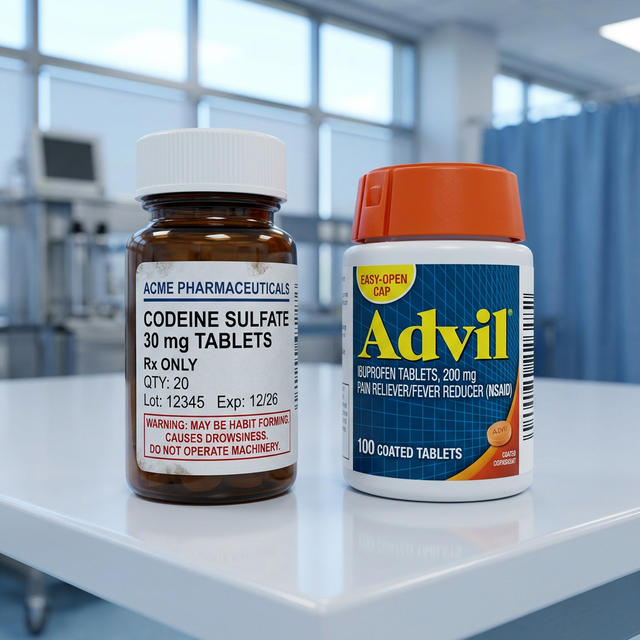
Advil (Ibuprofen) is a staple of American household medicine. Notable features:
- Anti-Inflammatory: Unlike Vicodin, Advil actually reduces the physical swelling and redness that cause pain.
- Accessibility: Available in almost every U.S. grocery store and gas station without a prescription.
- Safety: Carries zero risk of narcotic respiratory depression, making it much safer for the general American public.
In the USA, Advil is often considered a 'Foundation' drug for dental work and sport-related soft tissue injuries.
Mechanism of Action: How They Work
The biological pathways in the American patient are distinct:
- Vicodin (Targeting the Message): Hydrocodone travels to the brain and spinal cord, binding to the Mu-opioid receptors. It doesn't stop the injury from hurting; it stops the American brain from 'caring' or 'sensing' the signal.
- Advil (Targeting the Source): Advil inhibits the COX enzymes, which stops the body from creating prostaglandins—the chemicals that cause inflammation and sensitization. It 'turns down the volume' of pain at the site of the injury.
- Combined Synergy: U.S. clinical studies show that taking these together is often more effective than taking more Vicodin alone.
Receptor Fit & Chemical Blocking
Opioid Power
Vicodin (1.0 MME) vs Advil (0.0 MME).
Inflammation
Advil reduces physical swelling; Vicodin does not.
Onset Speed
Both take 30-60 minutes to start working in most U.S. adults.
Duration
Both last approx. 4-6 hours in the typical American system.
FDA-Approved vs. Off-Label Uses
Oversight by the U.S. FDA and clinical usage:
- Vicodin FDA: Relief of moderate to moderately severe pain.
- Advil FDA: Relief of minor aches and pains due to headache, toothache, and menstrual cramps; fever reduction.
- Dual Usage: Many U.S. medical boards now recommend 'Advil + Tylenol' (the ingredients in Advil and part of Vicodin) as the first line of defense before opioid use.
Potency and Clinical Strength
Understanding the Potency Gap (USA Data):
- The MME Measure: Because Advil is an NSAID, it has 0.0 Morphine Milligram Equivalents. It is not 'potency-limited' by breathing risks.
- Vicodin (1.0 MME): A 10mg dose of Vicodin is significantly more 'brain-altering' than a 400mg dose of Advil.
- Pain Thresholds: Advil is for pain scores 1-5; Vicodin is for pain scores 6-10.
Bioavailability & Metabolism
Processing and elimination in American patients:
- Vicodin (LIVER): Primary metabolism is in the liver. Excessive use is toxic to the liver due to its Acetaminophen component.
- Advil (KIDNEYS): Primary clearance is through the U.S. patient's kidneys. Long-term use or dehydration can lead to kidney strain or failure.
Half-Life & Duration of Action
The timeline of relief for American patients:
- Vicodin: 3.8 to 4.5 hours half-life. Effects fade for U.S. patients after 6 hours.
- Advil: 1.8 to 2.0 hours half-life. While it leaves the system fast, its anti-inflammatory effects often last 6-8 hours in the American body.
Clinical Efficacy and Indications
U.S. Clinical Applications:
- Wisdom Tooth Extraction: American dentists often prescribe *both*. Advil for the swelling, Vicodin for the 'nerve' pain.
- Back Spasms: Advil is actually better for the inflammation phase; Vicodin is used only if the patient cannot sleep.
- Fever: Advil reduces fever; Vicodin does not (though its Tylenol component does).
Typical Dosage and Administration
Typical U.S. Dosing Strategies:
- Advil: 200mg to 400mg every 4-6 hours (Max 1,200mg OTC / 3,200mg Rx per day).
- Vicodin: 1-2 tablets every 4-6 hours (Max 12/day).
- Interaction: You CAN take Advil and Vicodin at the same time in the USA, but you must NOT take Tylenol with Vicodin.
Side Effects and Adverse Reactions
Adverse reaction comparison for American patients:
- Vicodin: Constipation and respiratory slowing are the main risks.
- Advil: Stomach ulcers and gastrointestinal bleeding are the main long-term risks for U.S. users.
- Drowsiness: Vicodin causes severe sleepiness; Advil does not.
Comprehensive Side Effect Analysis
| Adverse Event | Vicodin (Narcotic) | Advil (NSAID) |
|---|---|---|
| Stomach Bleeding | Zero | Significant Risk |
| Constipation | Extremely High | Very Low |
| Respiratory Risk | Significant | Zero |
| Kidney Strain | Low | Significant |
| Addiction Potential | High | Zero |
🔴 Vicodin Risks
- Severe constipation
- Initial nausea peak
- Daytime drowsiness / brain fog
- Dry mouth
- Lightheadedness
🔴 Advil Risks
- Heartburn / Indigestion
- Nausea and stomach ache
- Ringing in the ears (tinnitus)
- Fluid retention (swelling)
- Possible dizziness
⚠ Critical Safety Note
Serious adverse reactions require immediate medical attention. The following are life-threatening signs:
- Fatal respiratory depression (Vicodin)
- Gastrointestinal 'Hole' / Perforation (Advil)
- Acute liver failure (Vicodin's Tylenol component)
- Heart Attack / Stroke risk (Advil in long-term U.S. use)
- Narcotic Use Disorder (Vicodin)
Safety, Addiction Risk, and Controlled Status
⚠ U.S. Regulation: CRITICAL (Vicodin) vs LOW (Advil)
Safety and Regulatory Environment in the USA:
- NARCAN Rule: U.S. guidelines suggest keeping Narcan nearby if using Vicodin. Advil requires no such antidote.
- Gut Protection: Many American doctors suggest taking Advil with milk or food to protect the stomach lining.
- Alcohol Interaction: Mixed with Vicodin = Overdose (Lungs). Mixed with Advil = Stomach Bleed. Do not drink in the USA with either.
- Vicodin is highly addictive; physical dependence can start in the USA after just 5-7 days.
- Advil is zero-addiction; it is not a controlled substance.
- Never mix Vicodin with other Tylenol-containing products (NyQuil, etc.).
- Report black/tarry stools if taking Advil routinely in the USA.
Pharmacy Cost & U.S. Healthcare Access
Availability and U.S. Pricing:
- Advil: Extremely cheap ($5-$15 for a large bottle).
- Vicodin: Inexpensive as a generic ($15-$30) but requires high pharmacy security.
Clinical Decision Flow: Which Should You Choose?
Clinical Decision Matrix for U.S. Physicians:
- Choose Advil: For arthritis, cramps, muscle strains, and fevers.
- Choose Vicodin: For acute surgical trauma, broken bones, and when Advil results in 0 relief.
U.S. Analgesic Escalation Path
Frequently Asked Questions
Yes, many U.S. surgeons recommend this multimodal approach. Because they work on different systems (Brain vs Inflammation), they provide better relief together.
No. Vicodin is a narcotic and is significantly more powerful at 'blocking' central pain. Advil is superior at reducing 'peripheral' swelling.
Yes. But you CANNOT take extra Tylenol with Vicodin, as Vicodin already contains it.
No. Standard U.S. drug tests look for opioids; Advil is not a controlled substance.
Because most back pain involves inflammation of the muscles/nerves. If the swelling goes down (via Advil), the pain often goes away permanently.