Codeine vs Tramadol: Clinical Comparison, Potency & Side Effects
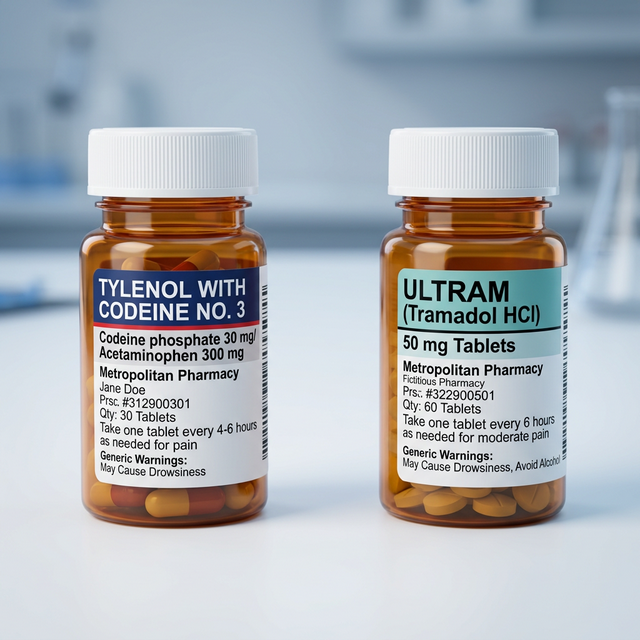
Codeine and Tramadol (Ultram) represent the standard 'Entry Level' of opioid pain management in the United States. They are frequently the first narcotics an American patient encounters after a dental extraction, a minor fracture, or for the management of chronic musculoskeletal aches. While both are considered 'weak' opioids compared to heavyweights like Fentanyl or Morphine, they operate via fundamentally different pharmacological pathways. Codeine is a natural derivative of the poppy plant, while Tramadol is a complex synthetic molecule with a unique dual-action mechanism.
Because both medications rely heavily on the liver's metabolic enzymes to provide relief, they are subject to significant genetic variability across the U.S. population. This 800+ word guide explores the 'Dual Action' SNRI property of Tramadol, the antitussive superiority of Codeine, and the specific seizure risks that differentiate these two American healthcare staples.

Dr. Kelsey Hopkins, MD
Dr. Hopkins practices rural family medicine in Southern Illinois, with a focus on community healthcare and chronic pain management.
Quick Reference Comparison
| Clinical Feature | Codeine | Tramadol |
|---|---|---|
| Drug Class | Natural Opiate | Synthetic Opioid / SNRI |
| Mechanism | Mu-Opioid (Morphine prodrug) | Mu-Opioid + Serotonin/Norepinephrine |
| Potency (MME) | 0.15 | 0.1 - 0.2 |
| Metabolism | CYP2D6 (Highly Variable) | CYP2D6 & CYP3A4 |
| DEA Schedule | Schedule III (Combo) or II | Schedule IV |
| Common Brands | Tylenol #3, Tylenol #4 | Ultram, ConZip, Ryzolt |
What is Codeine?

Codeine is a naturally occurring alkaloid derived from the opium poppy and is one of the oldest pain relievers used in the American healthcare system. It is primarily utilized for the management of mild-to-moderate pain and serves as a foundational antitussive (cough suppressant) in U.S. outpatient clinics. In the USA, Codeine is rarely dispensed as a lone ingredient; it is almost always mixed with Acetaminophen (Tylenol) and dispensed as T3 (30mg codeine) or T4 (60mg codeine).
The defining characteristic of Codeine in the USA is its genetic dependency. Codeine is a 'prodrug'—it has almost no pain-killing ability on its own. It must be converted into morphine by the liver’s CYP2D6 enzyme. Because of genetic variations, roughly 10% of the U.S. population receive zero relief (poor metabolizers), while others may have 'ultra-rapid' metabolism, leading to dangerous levels of active morphine in their system from small doses.
What is Tramadol?

Tramadol (Ultram) is a synthetic opioid that was introduced to the American market in 1995. Originally marketed as a 'lower-risk' alternative to traditional narcotics, it was reclassified as a DEA Schedule IV substance in 2014 by U.S. regulators due to evidence of physical dependency and abuse. Tramadol is unique among American painkillers because it possesses a Dual Action mechanism: it binds weakly to mu-opioid receptors like a narcotic, but it also inhibits the reuptake of serotonin and norepinephrine, similar to an antidepressant (SNRI).
This dual action makes Tramadol particularly effective in the USA for neuropathic (nerve) pain and chronic conditions like fibromyalgia or chronic back pain, where pure opioids often provide incomplete relief. However, this serotonergic property introduces a set of neurological risks that are not associated with Codeine.
Mechanism of Action: How They Work
Codeine and Tramadol represent two different philosophies of outpatient pain management in the USA:
- Codeine (Prodrug Opiate): Relies purely on the 'Morphine conversion' to block pain signals at the spinal cord and brain level. It is a traditional narcotic that simply dulls the perception of pain.
- Tramadol (The Hybrid): Works at the reception site (opioid) AND at the transmission site (serotonin/norepinephrine). By keeping more neurotransmitters in the synapses, Tramadol helps 'quiet' the nerves even before the signal reaches the brain. It also metabolizes into a more potent opioid molecule (O-desmethyltramadol) via the liver.
Biological Comparison
Metabolic Path
Codeine requires CYP2D6; Tramadol uses both 2D6 and 3A4.
Nerve Pain
Tramadol treats neuropathy via SNRI action; Codeine does not.
Cough Reflex
Codeine is a direct antitussive; Tramadol is not used for cough.
DEA Control
Tramadol is Schedule IV; Codeine is often Schedule III.
FDA-Approved vs. Off-Label Uses
- Codeine: FDA-approved for mild-to-moderate pain and cough suppression. It is strictly limited for U.S. pediatric and nursing populations.
- Tramadol: FDA-approved for moderate to severe pain in adults. Off-label U.S. uses include premature ejaculation and chronic restless leg syndrome (RLS).
Potency and Clinical Strength
When comparing milligram-for-milligram strength in the United States, Codeine and Tramadol are roughly equivalent on the WHO ladder. In American clinical guidelines, 30mg of Codeine provides approximately the same relief as 50mg of Tramadol. Both carry a Morphine Milligram Equivalent (MME) of roughly 0.1 to 0.15, making them approximately 10 times weaker than oral morphine baseline.
However, Tramadol possesses a Dangerous Seizure Ceiling. Unlike Codeine, which becomes less effective as the dose increases, Tramadol doses above 400mg per day significantly increase the risk of grand mal seizures in U.S. patients, regardless of their history of epilepsy.
Bioavailability & Metabolism
Codeine's bioavailability is roughly 50%, with extreme genetic variance. Tramadol has a significantly higher oral bioavailability of 75-95% and is metabolized by two different liver enzyme pathways (CYP2D6 and CYP3A4). This makes Tramadol slightly more reliable than Codeine for many American patients who may have 'blocked' metabolic pathways.
Half-Life & Duration of Action
Both medications are short-acting in their standard formats. Codeine lasts roughly 4-6 hours. Tramadol (immediate release) also lasts 4-6 hours, but its primary metabolite can linger longer. In the USA, Extended Release Tramadol (ConZip) is often used to provide 24-hour coverage for American chronic pain patients, an option not commonly used for Codeine.
Clinical Efficacy and Indications
U.S. clinical studies often show a slight edge for Tramadol in chronic fibromyalgia and nerve pain. Codeine remains the undisputed king of Antitussive therapy in American outpatient clinics. For post-operative dental pain, both are considered equally effective as a second-line measure when Ibuprofen is insufficient.
Typical Dosage and Administration
Codeine dosing in the USA typically starts at 30mg-60mg as needed. Tramadol dosing usually begins at 50mg. U.S. physicians strictly emphasize that Tramadol's daily dose must never exceed 400mg to prevent neurological toxicity.
Side Effects and Adverse Reactions
The side-effect profiles overlap on common opioid symptoms like constipation and nausea, but diverge sharply in their neurological impact. Codeine is more likely to cause significant sedation and histamine-induced 'itch,' while Tramadol can cause agitation, sweating, and Serotonin Syndrome if mixed with antidepressants in U.S. patients.
Comprehensive Side Effect Analysis
| Side Effect | Codeine (Opiate) | Tramadol (Synthetic) |
|---|---|---|
| Constipation | Very Severe | Moderate |
| Itching (Histamine) | High | Low |
| Seizure Risk | Minimal | High (at dose ceiling) |
| Mood Change | Sedation / Sleepy | Stimulation / Energy |
| Nausea / Vomit | Very Common | Common |
🔴 Codeine Risks
- Severe Constipation
- Drowsiness
- Heavy Itching
- Stomach Cramps
- Dry Mouth
🔴 Tramadol Risks
- Vertigo / Dizziness
- Nausea
- Heavy Sweating
- Insomnia
- Anxiety
⚠ Critical Safety Note
Serious adverse reactions require immediate medical attention. The following are life-threatening signs:
- Serotonin Syndrome (Tramadol)
- Lethal Respiratory Depression
- Grand Mal Seizures (Tramadol)
- Ultra-Rapid Metabolism Toxicity (Codeine)
Safety, Addiction Risk, and Controlled Status
⚠ U.S. Regulation: CODEINE: MODERATE / TRAMADOL: ATYPICAL-HIGH
The addiction profile of these two drugs is complex in the United States. Many U.S. patients experience a 'Dual Withdrawal' from Tramadol—resembling both an opioid withdrawal and an SSRI/antidepressant 'discontinuation syndrome' characterized by 'brain-zaps' and severe mood crashes.
Codeine Safety: Strictly restricted for U.S. children under 12 and nursing mothers due to the risk of fatal respiratory depression in fast metabolizers.
Tramadol Safety: Avoid if you have a history of epilepsy or are currently taking high-dose antidepressants (SSRIs or SNRIs) to prevent Serotonin Syndrome.
- Do not give Codeine to U.S. children under age 12.
- Avoid Tramadol if you have a history of seizures or head trauma.
- Tramadol can cause 'Brain Zaps' if discontinued abruptly in American patients.
- Never mix Tramadol with alcohol or other serotonergic drugs.
Pharmacy Cost & U.S. Healthcare Access
Both are extremely affordable in the United States. A standard generic supply of Tylenol #3 (Codeine) costs $10-$20. A 30-day supply of generic Tramadol 50mg can often be found for as low as $5-$12 with U.S. discount cards like GoodRx.
Clinical Decision Flow: Which Should You Choose?
The choice in American primary care often comes down to Pain Type and Patient Age. For acute recovery from a minor surgery or an intense cough, Codeine is often the first narcotic tried. For older U.S. patients with chronic 'arthritic' or 'nerve' pain who need to stay alert and functional during the day, Tramadol is frequently preferred due to its less sedating profile. However, clinicians will carefully screen American patients based on their current psychiatric medications before initiating Tramadol therapy.
Codeine vs. Tramadol Selection Logic
Frequently Asked Questions
Milligram for milligram, they are similar, but Tramadol is often perceived as better for chronic nerve pain because it also acts on serotonin.
Unlikely. Unlike some pure antidepressants, Tramadol is not commonly associated with significant weight gain in the USA.
Not recommended in the USA. Sudden cessation can cause both opioid and antidepressant-style withdrawal symptoms.