Gabapentin vs Oxycodone: Clinical Comparison, Potency & Side Effects
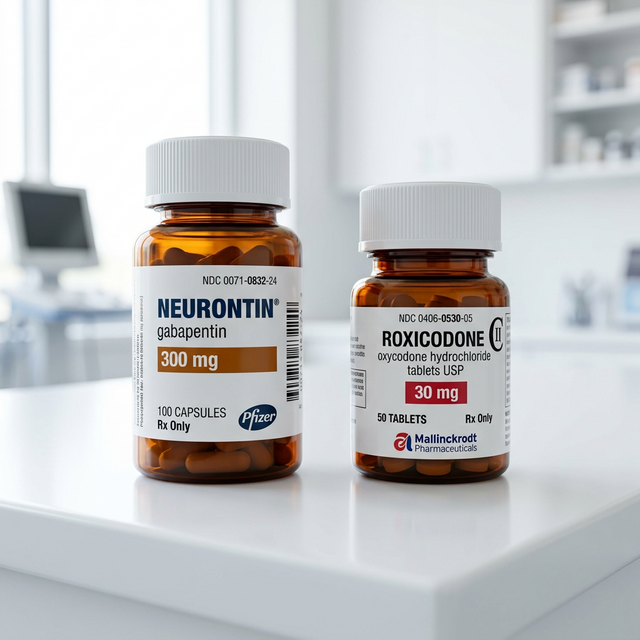
Gabapentin (Neurontin) and Oxycodone (Roxicodone, OxyContin) represent two vastly different tiers of American pain management. While they are often used together in complex 'multimodal' post-operative plans in the USA, they work through entirely separate mechanisms.
Gabapentin is a non-opioid used to quiet hypersensitive nerves, whereas Oxycodone is a potent Schedule II semi-synthetic opioid that acts directly on the brain's mu-opioid receptors. This guide explores why U.S. doctors use Gabapentin to 'spare' opioids, the different safety risks, and how the clinical goals shift when moving from nerve management to severe trauma relief.

Dr. Kelsey Hopkins, MD
Dr. Hopkins practices rural family medicine in Southern Illinois, with a focus on community healthcare and chronic pain management.
Quick Reference Comparison
| Clinical Feature | Gabapentin | Oxycodone |
|---|---|---|
| Drug Class | Gabapentinoid | Potent Semi-Synthetic Opioid |
| DEA Schedule | None / State Level V | Schedule II (High Control) |
| Potency (MME) | 0 (Non-narcotic) | 1.5 (Very High) |
| Primary Target | Calcium Channel Nerve Signals | Mu-Opioid Receptors (Central) |
| Common U.S. Brands | Neurontin | Percocet, Roxicodone, OxyContin |
What is Gabapentin?

Gabapentin is the primary non-opioid agent for chronic nerve pain in the United States. It stabilizes the electrical activity of nerves without the heavy 'central' sedation of narcotics. U.S. clinical guidelines increasingly favor Gabapentin to avoid the long-term dependency risks associated with opioids.
What is Oxycodone?

Oxycodone is one of the most powerful oral pain medications in the American pharmacy. It is reserved for severe acute pain (surgical) or intractable chronic pain (cancer). It is a highly controlled substance because of its significant potential for euphoria and dependence.
Mechanism of Action: How They Work
Gabapentin works primarily in the spinal cord to reduce the release of the chemicals that transmit pain. Oxycodone works in the brain and spinal cord to mimic the body's natural endorphins, essentially 'closing the gate' on pain perception. In modern U.S. hospitals, using both can target 'site' pain and 'nerve' pain simultaneously.
Opioid vs. Non-Opioid Targeting
VGCC Blockade
Gabapentin slows down overactive nerve impulses.
Mu-Receptor Agonism
Oxycodone binds to receptors to block pain perception.
Opioid-Sparing
Using Gabapentin allows for a lower, safer Oxycodone dose.
FDA-Approved vs. Off-Label Uses
- Gabapentin: FDA-Approved for PHN and Seizures. Widely used for Sciatica and Neuropathy Off-Label.
- Oxycodone: FDA-Approved for Moderate to Severe Acute and Chronic pain management.
Potency and Clinical Strength
Oxycodone is approximately 1.5x more powerful than Morphine. Gabapentin has no narcotic potency but is clinically 'stronger' for chronic burning pain that opioids often fail to touch.
Bioavailability & Metabolism
Oxycodone is metabolized by the liver into several active metabolites. Gabapentin is not metabolized by the liver at all; it passes in and out of the body through the kidneys. This makes it a critical 'liver-safe' alternative in the USA.
Half-Life & Duration of Action
Oxycodone IR has a shorter half-life (3.2 hours) than Gabapentin (5-7 hours). This means Oxycodone relief hits hard and fast but wears off sooner than Gabapentin's more stable 'background' relief.
Clinical Efficacy and Indications
Oxycodone is unrivaled for acute surgical trauma. Gabapentin is the gold standard for long-term neuropathy. In U.S. 'ERAS' (Recovery) protocols, the goal is to phase out Oxycodone while maintaining Gabapentin.
Typical Dosage and Administration
Oxycodone is dosed in small increments (5mg-30mg). Gabapentin is dosed in hundreds of milligrams (300mg-1200mg). Never confuse these doses, as a 300mg dose of Oxycodone would be fatal.
Side Effects and Adverse Reactions
Both cause significant sedation. However, Oxycodone's most common struggle is severe constipation and nausea, while Gabapentin's is dizziness and leg swelling.
Comprehensive Side Effect Analysis
| Side Effect | Gabapentin Profile | Oxycodone Profile |
|---|---|---|
| Constipation | Very Low | Extreme / Universal |
| Nausea | Rare | High |
| Dizziness | High | Moderate |
| Dependency Risk | Low | Extremely High |
🔴 Gabapentin Risks
- Dizziness
- Drowsiness
- Peripheral Edema (Swelling)
🔴 Oxycodone Risks
- Constipation
- Pruritus (Itching)
- Nausea/Vomiting
⚠ Critical Safety Note
Serious adverse reactions require immediate medical attention. The following are life-threatening signs:
- Respiratory Arrest (Stopping breathing)
- Overdose Syndrome
- Severe Allergic Reaction
Safety, Addiction Risk, and Controlled Status
⚠ U.S. Regulation: Schedule II (Oxycodone) / Unscheduled (Gaba)
Oxycodone carries a high potential for addiction, misuse, and fatal overdose. The U.S. FDA issued a safety alert specifically warning that combining Gabapentin with opioids drastically increases the risk of breathing failure. This combination must be monitored with extreme care.
- Oxycodone has a double Black Box Warning for addiction and respiratory risk.
- Gabapentin increases the CNS damping effect of Oxycodone.
- Naloxone (Narcan) is often co-prescribed in the USA for this combination.
Pharmacy Cost & U.S. Healthcare Access
Both are available in low-cost generic forms. However, Oxycodone prescriptions are strictly limited in the USA (often to a 3-7 day supply for acute pain) due to regulatory laws.
Clinical Decision Flow: Which Should You Choose?
Choosing between them is a matter of 'Nerve' vs 'Trauma'.
U.S. Clinical Decision Logic
Frequently Asked Questions
For pure nerve pain, often yes. For a fresh surgical incision or a broken bone, Gabapentin is typically not strong enough to be the sole agent.
No, it is a non-narcotic anti-convulsant.
It is a less potent molecule that requires larger gram-scale amounts to cross the blood-brain barrier effectively.