Gabapentin vs Pregabalin: Clinical Comparison, Potency & Side Effects
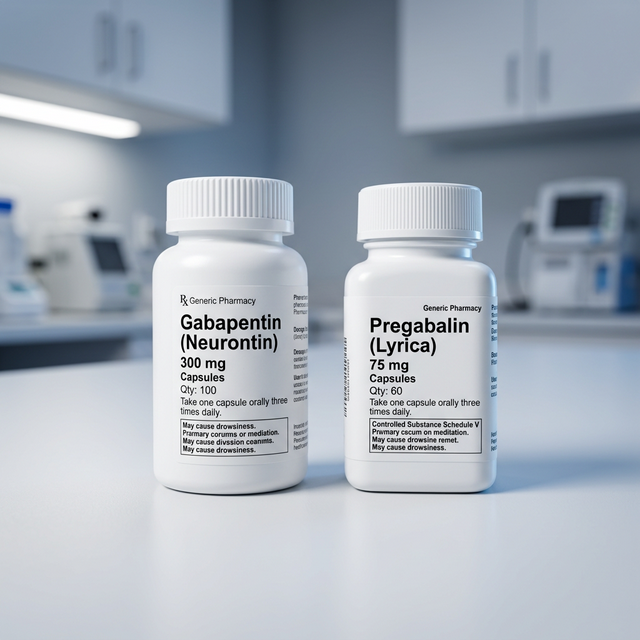
Gabapentin (Neurontin) and Pregabalin (Lyrica) are the two most common 'gabapentinoid' medications prescribed in the United States for neuropathic pain. While they are chemically similar and share the same biological target—the alpha-2-delta subunit of voltage-gated calcium channels—they behave very differently once inside the human body.
The primary clinical distinction in the USA is not just potency, but predictability. Transitioning from Gabapentin to Pregabalin is a common move for U.S. patients who find that higher doses of Gabapentin simply stop being absorbed due to the 'ceiling effect'. This guide explains the pharmacokinetic lottery, the cost differences, and the state-level regulations surrounding these critical nerve pain agents.

Dr. Kelsey Hopkins, MD
Dr. Hopkins practices rural family medicine in Southern Illinois, with a focus on community healthcare and chronic pain management.
Quick Reference Comparison
| Clinical Feature | Gabapentin | Pregabalin |
|---|---|---|
| Primary Brand | Neurontin | Lyrica |
| Absorption type | Saturable (Non-linear) | Predictable (Linear) |
| Bioavailability | 30-60% (decreases with dose) | ≥90% (constant) |
| DEA Schedule | Unscheduled / State Level V | Schedule V (Federal) |
| Standard Dosing | 300mg - 1200mg TID | 75mg - 300mg BID/TID |
What is Gabapentin?

Gabapentin is an anti-epileptic drug (AED) that revolutionized the treatment of neuropathic pain in the United States. Originally developed for seizures, it is now primarily used for 'nerve calming' in conditions like shingles (PHN), diabetic neuropathy, and chronic back pain. In the USA, it is valued for its non-opioid status and low cost as a generic.
What is Pregabalin?

Pregabalin (Lyrica) is considered the 'next generation' gabapentinoid. It was designed to overcome the absorption limits of its predecessor. Because it is much more potent and reliably absorbed, it is often preferred in U.S. clinical guidelines for more severe or systemic nerve conditions like Fibromyalgia and spinal cord injury pain.
Mechanism of Action: How They Work
Both medications function as ligands for the alpha-2-delta-1 subunit of voltage-gated calcium channels in the CNS. By binding here, they reduce the entry of calcium into nerve terminals, which in turn stops the over-release of excitatory neurotransmitters like glutamate. Essentially, they 'turn down the volume' on hyper-excited nerves.
Cellular Mechanism Comparison
Target Site
Both bind to alpha-2-delta subunit of VGCC.
Binding Affinity
Pregabalin has a much higher affinity for the target site.
Active Transport
Gabapentin depends on saturable LAT-1 transport; Pregabalin does not.
FDA-Approved vs. Off-Label Uses
- Gabapentin (FDA): Postherpetic Neuralgia (PHN), Partial Seizures.
- Pregabalin (FDA): Diabetic Neuropathy, PHN, Fibromyalgia, Spinal Cord Injury Pain, Partial Seizures.
- Common Off-Label (Both): Restless Leg Syndrome, Anxiety, Chronic Back Pain, Alcohol Withdrawal.
Potency and Clinical Strength
Pregabalin is significantly more potent than Gabapentin. In clinical transitions, U.S. doctors typically use a 6:1 or 3:1 conversion ratio. For example, 1800mg of Gabapentin may be roughly equivalent to 300mg of Pregabalin in terms of therapeutic effect, though individual response varies greatly.
Bioavailability & Metabolism
The 'Saturable Absorption' of Gabapentin is its defining clinical weakness. As the dose increases, the percentage absorbed *decreases*. This means doubling your dose does NOT double the amount in your blood. Pregabalin has linear absorption—if you double the dose, you double the blood levels. This makes Pregabalin far more predictable for U.S. providers.
Half-Life & Duration of Action
Both have relatively short half-lives (5-7 hours). However, Pregabalin reaches peak plasma concentrations significantly faster (within 1 hour) than Gabapentin (2-3 hours). This leads to a faster onset of relief for many American patients.
Clinical Efficacy and Indications
While both are effective for nerve pain, Pregabalin has more robust FDA-approved data for Fibromyalgia. Both are used extensively in U.S. 'Opioid-Sparing' protocols to reduce the need for narcotics after surgery.
Typical Dosage and Administration
Gabapentin doses are typically much higher (up to 3600mg/day) compared to Pregabalin (max 600mg/day). Both require slow titration in the USA to avoid the 'cognitive fog' associated with starting these agents.
Side Effects and Adverse Reactions
The side effect profiles are remarkably similar, as they share the same biological pathway. However, the intensity of certain effects like weight gain can differ between U.S. patient populations.
Comprehensive Side Effect Analysis
| Side Effect | Gabapentin Frequency | Pregabalin Frequency |
|---|---|---|
| Dizziness | High | Very High |
| Somnolence | High | High |
| Peripheral Edema | Moderate | High |
| Weight Gain | Moderate | High |
| Blurred Vision | Low | Moderate |
🔴 Gabapentin Risks
- Dizziness
- Somnolence
- Ataxia (unsteadiness)
🔴 Pregabalin Risks
- Dizziness
- Peripheral Edema
- Weight Gain
⚠ Critical Safety Note
Serious adverse reactions require immediate medical attention. The following are life-threatening signs:
- Angioedema (face swelling)
- Respiratory Depression (especially when mixed)
- Suicidal Ideation
Safety, Addiction Risk, and Controlled Status
⚠ U.S. Regulation: Schedule V / Controlled Substance
While Gabapentin is not a federal controlled substance, many U.S. states (Kentucky, Ohio, etc.) have classified it as Schedule V due to its potential for misuse when combined with opioids. Pregabalin is a Federal Schedule V medication throughout the United States.
- Do not mix with alcohol or CNS depressants.
- Must be tapered slowly; abrupt stop can cause seizures.
- Higher risk in patients with prior substance use history.
Pharmacy Cost & U.S. Healthcare Access
Gabapentin is ubiquitous and very inexpensive in the USA. Pregabalin, while now available as a generic, remains slightly higher in cost and may require 'Step Therapy' on some insurance formularies (meaning you must fail on Gabapentin first).
Clinical Decision Flow: Which Should You Choose?
Choosing between these two depends on cost, the specific condition (like Fibromyalgia), and how well the patient absorbs Gabapentin.
Gabapentinoid Selection Process
Frequently Asked Questions
Yes, it is more potent and more reliably absorbed by the body.
No. They work on the same target and taking both increases side effect risks without added benefit.
Yes, it can, though it is often reported less frequently than with Pregabalin.