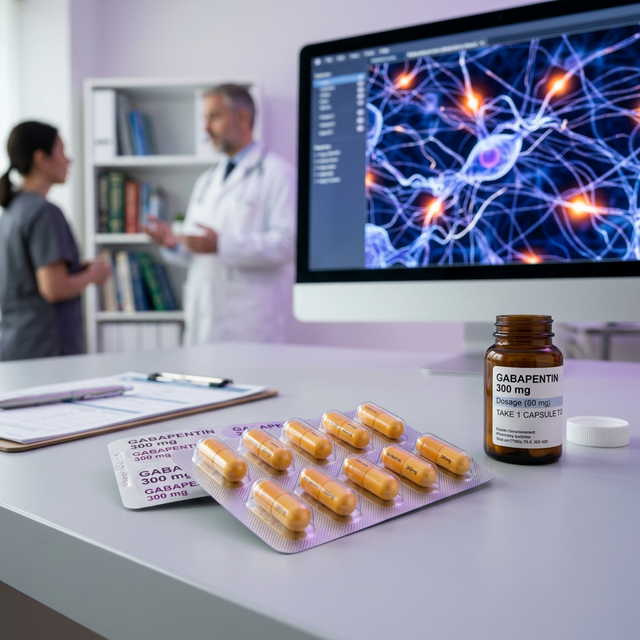

What is this medication
Gabapentin is widely recognized by its prominent U.S. brand name, Neurontin.
It is a synthetic analogue of the neurotransmitter gamma-aminobutyric acid (GABA).
First approved by the FDA in 1993 for partial seizures, its role in U.S. medicine has massively transformed. Today, over 90% of prescriptions are written "off-label" to treat neuropathic pain.
It belongs to the anticonvulsant class but is clinically termed a "gabapentinoid," alongside pregabalin (Lyrica).
- Not an NSAID: Unlike ibuprofen, it does not treat physical physical tissue inflammation.
- Not an Opioid: Unlike oxycodone, it does not blunt pain at opioid receptors.
- Nerve Stabilizer: It actively calms hyperexcitable nerve cells in the central nervous system.
| Clinical Specification | Detail |
|---|---|
| Chemical Name | 2-[1-(aminomethyl)cyclohexyl]acetic acid |
| Pharmacologic Class | Anticonvulsant, GABA Analogue |
| FDA Approval | 1993 (Epilepsy), 2002 (Postherpetic Neuralgia) |
| Common U.S. Brands | Neurontin, Gralise, Horizant |
What is it used for
In the United States, gabapentin holds very few official FDA approvals.
In the United States, the primary FDA-approved use for Gabapentin in adults is for Postherpetic Neuralgia (PHN)—the nerve pain following shingles. However, it is extensively used 'off-label' for diabetic neuropathy:
However, its cornerstone use in U.S. medicine lies in massive off-label prescribing for chronic pain:
- Diabetic Neuropathy: A frontline treatment for painful burning and tingling in diabetic feet and hands. (See our guide on nerve pain relief).
- Fibromyalgia: Prescribed off-label to calm widespread nerve sensitivity and improve sleep.
- Sciatica and Radiculopathy: Chronic shooting leg pain caused by herniated discs in the lower back. Learn more about sciatica nerve relief.
- Addiction Protocols: Increasingly utilized to mitigate severe alcohol or opioid withdrawal symptoms and cravings.
How it works
Despite mimicking GABA structurally, gabapentin does not bind to actual GABA receptors.
It derives its efficacy through a highly specific mechanism: High-affinity binding to the alpha-2-delta (α2δ) subunit of voltage-gated calcium channels in the central nervous system.
The Nerve Silencing Process
Dosage guide
Gabapentin dosing requires significant clinical finesse due to non-linear pharmacokinetics.
As the dose increases, the body's ability to absorb the drug actually decreases.
U.S. clinicians strict adhere to a slow titration schedule to minimize debilitating dizziness.
| Clinical Stage | Standard Protocol (Neurontin) | Goal / Notes |
|---|---|---|
| Day 1 Initiation | 300mg once daily (typically at bedtime) | Assess initial tolerability to extreme sedation. |
| Titration Phase | Increase by 300mg every 1-3 days | Build up steadily to 900mg/day (300mg taken 3 times daily). |
| Maintenance Phase | 900mg to 3,600mg per day, divided in 3 doses | Pain relief is frequently absent until doses exceed 1,800mg daily. |
Side effects
Gabapentin avoids heavily impacting the liver or heart, making it generally well-tolerated.
However, its central nervous system effects are profound during the dose buildup.
- Severe Somnolence: Extreme drowsiness and fatigue are the primary reasons patients quit therapy.
- Dizziness & Ataxia: Unsteadiness and poor coordination create significant fall risks in geriatric patients.
- Peripheral Edema: Noticeable fluid swelling occurs in the hands, legs, and feet.
- Weight Gain: Mild to moderate sustained weight gain is common in long-term users.
Warnings and precautions
Critical USA Precautions:
- Sudden Discontinuation: Stopping abruptly can trigger severe withdrawal, rebound nerve pain, and non-stop seizures. Always taper slowly.
- Suicidal Ideation: Like all anti-epileptic drugs, gabapentin carries an FDA warning for increased suicide risk.
Drug interactions
Gabapentin avoids the liver's infamous CYP450 enzymes completely.
However, dangerous synergistic interactions still exist:
- Opioids (Morphine / Hydrocodone): Combining these dramatically increases sedation and the risk of fatal respiratory depression.
- Antacids (Maalox / Mylanta): Aluminum and magnesium drastically reduce gabapentin absorption. Take gabapentin 2 hours *after* antacids.
- CNS Depressants: Alcohol and benzodiazepines violently compound the severe motor impairment caused by gabapentin.
Alternatives
When gabapentin fails or causes intolerable sedation, U.S. clinicians pivot entirely:
- Pregabalin (Lyrica): The direct successor. It absorbs perfectly, requiring smaller doses, but is a federally controlled substance.
- SNRIs (Duloxetine / Cymbalta): Highly effective non-sedating alternatives for diabetic neuropathy and fibromyalgia.
- Tricyclic Antidepressants (Amitriptyline): Older, highly effective nerve pain alternatives used at very low, sleep-inducing doses.
Cost in the United States
Gabapentin is incredibly cost-effective in the U.S. due to early patent expirations.
| Formulation Type | Cost Details & Coverage |
|---|---|
| Generic Capsules / Tablets | Universally covered as a Tier 1 generic. Cash prices without insurance range from just $10 to $25 monthly. |
| Brand Name (Neurontin) | Rarely dispensed. Costs over $300/month and is heavily blocked by insurance prior-authorizations. |
| Extended Release (Gralise) | Specialized ER formulations remain expensive ($400-$600/month) and face heavy insurance hurdles. |
Availability in the US healthcare system
Gabapentin is ubiquitously available, but its legal status is actively changing.
- Federal Status: The DEA does not currently classify it as a controlled substance.
- State Status: Due to drug abusers pairing it with heroin, several states (Kentucky, Virginia, Michigan) have legally scheduled it as a C-V controlled substance.
Comparison with other medications
Gabapentin's role is best understood when compared against its closest U.S. rivals.
| Medication Comparison | Key Differences & Clinical Profile |
|---|---|
| Gabapentin vs. Lyrica | Both target the exact same calcium channels. Lyrica is vastly more potent and absorbs instantly, but is federally controlled and expensive. Gabapentin is cheaper but harder for the body to absorb. |
| Gabapentin vs. Tramadol | Tramadol is a weak opioid carrying addiction risks. Gabapentin has zero opioid properties and functions exclusively by quieting electrical nerve signals. |
Safety guidance
Patients beginning gabapentin must fiercely adhere to strict safety protocols.
- Patience is Mandatory: Gabapentin is not an instant painkiller. It requires 2 to 4 weeks of dose building before nerve pain subsides.
- Renal Dosing: It is excreted entirely unchanged by the kidneys. Patients with kidney disease must have their dose drastically reduced to prevent toxicity.
- Fall Precautions: Dizziness makes falls highly likely in the first month. Rise slowly and alter the home to prevent tripping.
Frequently Asked Questions
Is Gabapentin an opioid painkiller?
Why did my doctor prescribe me an epilepsy drug for my back pain?
What does 'off-label' prescribing mean in the USA?
Why do I have to take Gabapentin three times a day?
Is Gabapentin addictive?
Will Gabapentin make me gain weight?
Can I drink alcohol while taking Gabapentin?
How long does it take for Gabapentin to stop my nerve pain?
What are the withdrawal symptoms if I stop Gabapentin cold turkey?
Does Gabapentin show up on a standard U.S. employer drug test?
Why is my dose so high? I take 2,700mg a day, is that safe?
Is Gabapentin safe during pregnancy?
Can gabapentin help with anxiety or sleep?
Do I need to take Gabapentin with food?
What is the difference between Gabapentin and Lyrica?
Expert Verified Content
This clinical guide on Gabapentin has been reviewed for accuracy by the US Pain Meds Medical Review Board, adhering to current FDA, NIH, and CDC standards in the United States.
Clinical References & Authority Sources
- U.S. Food and Drug Administration (FDA). Drugs@FDA Database.
- National Institutes of Health (NIH). DailyMed Library.
- Centers for Disease Control and Prevention (CDC). Pain Management Guidelines.
- Drug Enforcement Administration (DEA). Controlled Substance Act Schedules.